
Joint Task Offloading, Inference Optimization and UAV Trajectory Planning for Generative AI Empowered Intelligent Transportation Digital Twin
Drone-based AI image generation could keep city traffic digital twins accurate in real time — but the system is theoretical and untested in the real world.
The Thesis
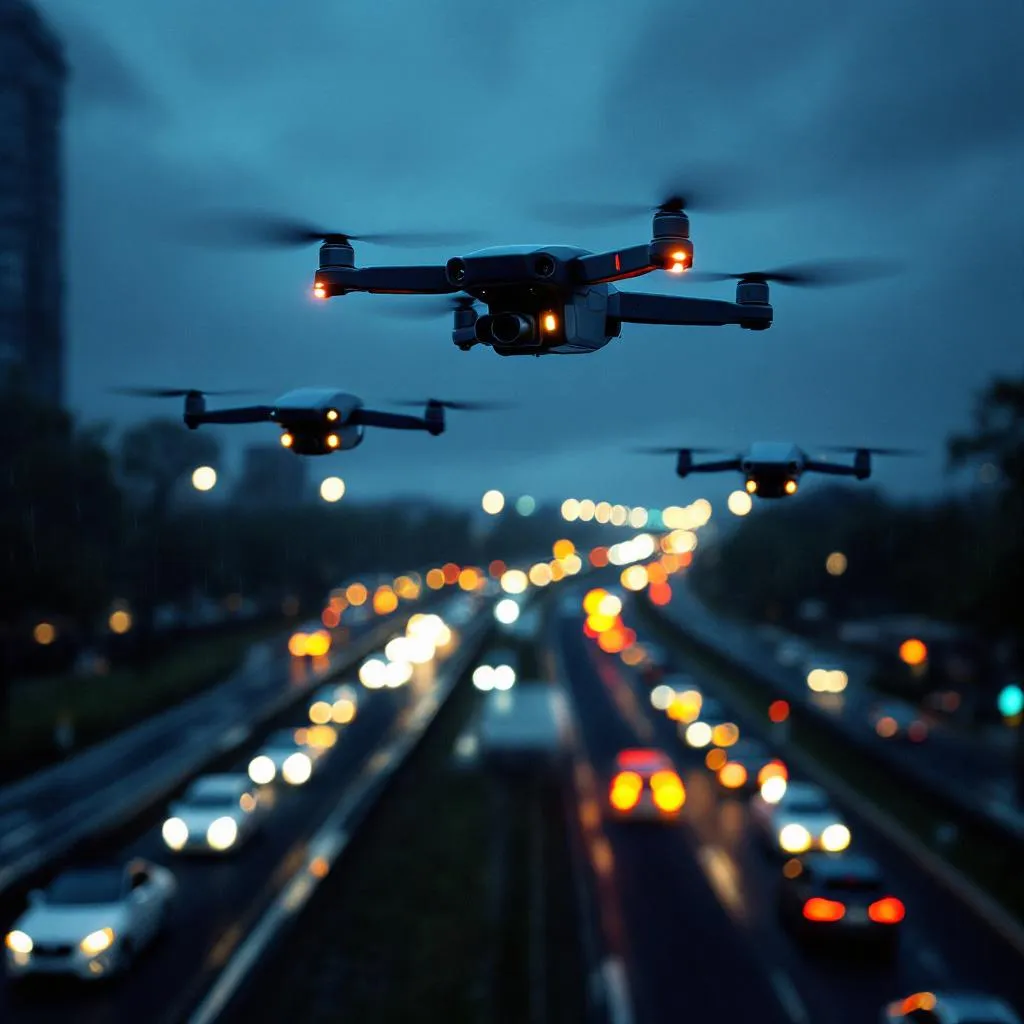
Cities are increasingly building 'digital twins' — live virtual replicas of physical infrastructure like roads and intersections — to improve traffic management and autonomous vehicle coordination. This paper proposes a system where fleets of drones carry AI image-generation models (specifically diffusion models, the same class of technology behind tools like Stable Diffusion) to process raw sensor data from roadside cameras and sensors into high-quality, usable data feeds. The core challenge the authors tackle is a tradeoff: running more sophisticated AI on the drone produces better data but takes longer, while faster processing may yield lower-quality outputs. They design a reinforcement-learning algorithm — a type of machine learning where an agent learns by trial and error — to simultaneously decide which drone processes which task, how much AI inference to run, and what flight path each drone should take. The catch is that this is a simulation study with no hardware validation, real traffic data, or deployment results.
Catalyst
Diffusion models have matured rapidly since 2022 and are now compact enough to run on edge hardware, making on-device AI inference on drones plausible for the first time. Simultaneously, urban digital-twin deployments are accelerating, driven by smart city initiatives in Asia and Europe, creating a real demand problem that this kind of system would address. The multi-agent reinforcement learning frameworks needed to coordinate heterogeneous fleets — different drones with different capabilities — have also improved substantially, making the optimization approach here tractable.
What's New
Earlier digital-twin offloading research typically assumed static ground-based edge servers or simple task queues, and most UAV-assisted computing papers treated inference as a black box with fixed cost. This paper explicitly models the number of diffusion model denoising steps — the internal computation budget of the AI — as a tunable variable, so the system can trade off output quality against latency. The authors also introduce a 'sequential update' mechanism within their multi-agent reinforcement learning algorithm to stabilize training when multiple heterogeneous agents (drones with different roles) are learning simultaneously, which they claim speeds convergence compared to standard baselines.
The Counter
This paper is a simulation study with no real drones, no real traffic data, and no real diffusion model deployed on constrained hardware. The comparisons are against 'baseline algorithms' defined by the authors themselves in the same simulated environment — not against real-world deployed systems. Running a diffusion model on a drone is a non-trivial engineering challenge: even the smallest diffusion models require meaningful GPU memory and power, and drone battery life is measured in 20-40 minutes. The paper does not address how denoising quality actually translates to digital-twin accuracy in practice, or what happens when wireless links to ground infrastructure are degraded. Multi-drone reinforcement learning systems are notoriously brittle outside training distributions, and urban airspace regulation in most jurisdictions would make deploying fleets of data-processing drones over city roads legally complex for years. The combination of generative AI, UAVs, digital twins, and multi-agent RL in a single paper reads more as a trend-stacking exercise than a focused engineering contribution.
Longs
- AVAV (AeroVironment) — drone hardware that could host edge AI payloads
- MVIS (MicroVision) — roadside lidar sensors feeding digital-twin systems
- QCOM — Snapdragon edge AI chips increasingly deployed in drone compute modules
- BOTZ (Global Robotics & AI ETF) — broad exposure to autonomous systems and edge AI
- Mobileye (MBLY) — smart infrastructure data layer that overlaps with transportation digital twins
Shorts
- Fixed roadside edge-compute vendors (e.g., companies selling stationary MEC servers to cities) — mobile drone compute could reduce demand for static infrastructure if this approach proves economical
- Traditional traffic camera analytics firms — if diffusion-model-enhanced data pipelines replace their lower-fidelity sensor fusion products
Enablers (Picks & Shovels)
- NVIDIA Jetson platform — the primary edge GPU module for running diffusion inference on drones today
- ROS 2 (Robot Operating System) — open-source middleware for coordinating multi-drone fleets
- Stable Diffusion / Hugging Face diffusion model libraries — open-source inference stacks the system would build on
- OpenStreetMap and city LiDAR datasets — the kind of ground-truth data needed to validate digital-twin fidelity claims
Private Watchlist
- Lattice Technology — edge AI inference optimization for constrained hardware
- Skydio — autonomous drone fleets with onboard compute, direct adjacency to this use case
- Cityzenith — urban digital-twin platform vendor
- Neurala — edge AI for drone perception and data processing
Resources
The Paper
To implement the intelligent transportation digital twin (ITDT), unmanned aerial vehicles (UAVs) are scheduled to process the sensing data from the roadside sensors. At this time, generative artificial intelligence (GAI) technologies such as diffusion models are deployed on the UAVs to transform the raw sensing data into the high-quality and valuable. Therefore, we propose the GAI-empowered ITDT. The dynamic processing of a set of diffusion model inference (DMI) tasks on the UAVs with dynamic mobility simultaneously influences the DT updating fidelity and delay. In this paper, we investigate a joint optimization problem of DMI task offloading, inference optimization and UAV trajectory planning as the system utility maximization (SUM) problem to address the fidelity-delay tradeoff for the GAI-empowered ITDT. To seek a solution to the problem under the network dynamics, we model the SUM problem as the heterogeneous-agent Markov decision process, and propose the sequential update-based heterogeneous-agent twin delayed deep deterministic policy gradient (SU-HATD3) algorithm, which can quickly learn a near-optimal solution. Numerical results demonstrate that compared with several baseline algorithms, the proposed algorithm has great advantages in improving the system utility and convergence rate.